
Samsung 55-Inch Crystal UHD 4K Vision AI vs Xiaomi 55-Inch FX Pro 4K QLED: Which Smart TV Should You Buy in 2026?
Choosing a 55-inch 4K Smart TV can be confusing, especially when two popular options offer different display technologies, sound systems, gaming features, and smart TV platforms. Samsung vs Xiaomi 55-inch TV – The Samsung 55-inch Crystal UHD 4K Vision AI Smart TV (UA55UE85AHULXL) focuses on 4K upscaling, HDR10+, AI-powered features, and long-term operating system upgrades. On the other hand, the Xiaomi 55-inch Smartchoice FX Pro 4K QLED Smart TV (L55MB-FPIN) highlights QLED display technology, 34W box speakers, a 120Hz Game Booster, Filmmaker Mode, and Fire TV.
Affiliate Disclosure: This blog post may contain affiliate links, including Amazon affiliate links. If you purchase a product through these links, we may earn a commission at no additional cost to you. As an Amazon Associate, we earn from qualifying purchases. Our product comparisons and recommendations are intended to help readers make informed buying decisions.
Disclaimer: The information provided in this blog is for general informational and educational purposes only. Product specifications, features, prices, discounts, availability, warranty terms, and software support may change without notice. We make reasonable efforts to provide accurate information, but we do not guarantee that all details are complete, current, or error-free. Please verify the latest information on the manufacturer’s official website or the seller’s product page before making a purchase. Actual product performance may vary depending on usage, settings, software updates, and other factors. Purchasing decisions are the sole responsibility of the buyer.
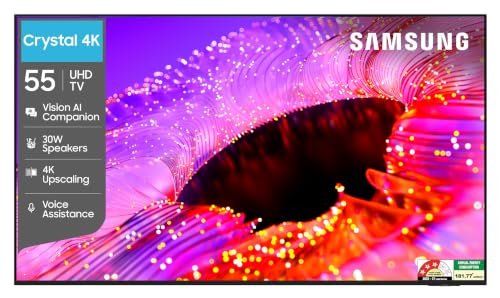

Both televisions offer a 55-inch 4K viewing experience, but they target slightly different buyer priorities.
Let’s compare their specifications, practical benefits, advantages, limitations, and the type of user each TV may suit best.
1. Samsung vs Xiaomi 55-Inch TV: Specifications Comparison
| Feature | Samsung Crystal UHD 4K Vision AI | Xiaomi Smartchoice FX Pro 4K QLED |
|---|---|---|
| Model number | UA55UE85AHULXL | L55MB-FPIN |
| Screen size | 55 inches (138 cm) | 55 inches (139 cm) |
| Resolution | 4K UHD | 4K UHD |
| Display technology | Crystal UHD LED LCD | QLED |
| HDR support | HDR10+ | HDR10+ |
| Sound output | 30W speakers | 34W box speakers |
| Upscaling | 4K upscaling | 4K resolution; confirm supported upscaling features |
| Gaming feature | Check model-specific gaming specifications | 120Hz Game Booster |
| Picture mode | Check available modes | Filmmaker Mode |
| Smart TV platform | Samsung smart TV platform | Fire TV |
| Content access | Smart TV apps and channels | Fire TV apps and content |
| Free TV channels | 150+ channels advertised | Check included channel services |
| Operating system upgrades | 7 years advertised | Check model-specific software support |
| Best-known strengths | Software support, upscaling, smart features | QLED, higher-rated speaker output, gaming-focused feature |
Specifications are based on the supplied product descriptions. Features, channel availability, supported formats, and software policies should be verified on the respective official product pages before purchase.
2. Samsung vs Xiaomi 55-inch TV – Display Quality: Crystal UHD vs QLED
Samsung Crystal UHD 4K Vision AI
Samsung’s Crystal UHD technology uses an LED LCD panel with image processing designed to improve colour reproduction and picture clarity.
What does it mean for everyday viewing?
- 4K resolution: Provides detailed images on a 55-inch screen when watching native 4K content.
- 4K upscaling: Can improve the appearance of lower-resolution content by processing it to suit the screen’s 4K resolution.
- HDR10+: Supports compatible HDR content with scene- or frame-based adjustments to the picture’s tone mapping.
- AI-related picture processing: May help optimise the viewing experience, depending on the features supported by this particular model.
This TV may appeal to people who watch television channels, streaming services, films, and mixed-resolution content.
Xiaomi Smartchoice FX Pro 4K QLED
Xiaomi uses QLED technology, which typically adds a quantum-dot colour layer to an LED LCD display. This can help deliver a wider range of colours than conventional LCD implementations.
What does it mean for everyday viewing?
- QLED display: Can produce vivid, rich colours, depending on the panel and picture settings.
- 4K resolution: Provides detailed images from compatible 4K content.
- HDR10+: Enables compatible HDR playback.
- Filmmaker Mode: Designed to present supported films closer to the creator’s intended picture settings, where implemented by the TV.
For buyers who enjoy colourful films, animated content, sports, and streaming entertainment, QLED is an attractive feature.
Display verdict: Xiaomi has the technology advantage on paper because it explicitly offers QLED. However, the label alone does not establish which TV has better contrast, black levels, brightness, reflection handling, or overall picture quality. Those depend on the actual panel and processing.
3. Sound Quality: 30W vs 34W Box Speakers
Audio is another important difference between these two televisions.
Samsung vs Xiaomi 55-inch TV – Samsung: 30W speakers, Xiaomi: 34W box speakers
Samsung advertises a 30W speaker system. This should be suitable for everyday programmes, news, television shows, and casual streaming, depending on the room and listening distance.
Xiaomi advertises 34W box speakers. Its higher stated output and box-speaker design may be attractive to buyers who want a more substantial built-in audio setup.
However, wattage alone does not determine sound quality. Speaker design, tuning, dialogue clarity, bass response, distortion, and room acoustics also matter.
Sound verdict: Xiaomi wins on advertised speaker output, with 34W compared with Samsung’s 30W. Listen to both if possible, particularly if you watch action films or sports without an external sound system.
4. Gaming Features: Xiaomi’s 120Hz Game Booster
Xiaomi advertises a 120Hz Game Booster, making gaming an important part of this model’s positioning.
This feature may be useful for supported gaming scenarios, but buyers should distinguish between a gaming enhancement feature and a native 120Hz panel.
Before buying, verify:
- The panel’s native refresh rate.
- Whether 120Hz operation is available at 4K or only at a lower resolution.
- Supported HDMI input capabilities.
- Input lag and available gaming modes.
- Compatibility with your console or PC.
Do not assume that the phrase “120Hz Game Booster” guarantees native 120Hz 4K input.
For Samsung, check the exact model’s native refresh rate, gaming modes, HDMI specifications, and compatibility with your gaming device before comparing performance.
Gaming verdict: Xiaomi has the more explicitly advertised gaming feature. It is the more interesting option on paper for gaming-focused buyers, but the technical details need confirmation before making a final decision.
5. Smart TV Experience: Samsung Platform vs Fire TV
Samsung Smart TV
Samsung’s smart TV platform provides access to supported streaming apps and connected entertainment features. The product description also advertises 150+ channels.
Its appeal includes a familiar smart TV interface and a stated seven-year operating system upgrade commitment.
Xiaomi Fire TV
The Xiaomi model uses Fire TV, an interface built around streaming content, supported applications, and connected entertainment services.
It may be particularly appealing to households already familiar with Fire TV devices and its content-discovery experience.
Check the app availability, voice-assistant support, account requirements, and regional services relevant to your household.
Smart TV verdict: Neither platform is automatically better for every user. Choose Samsung if its interface, supported apps, and long-term upgrade commitment suit your needs. Choose Xiaomi if you prefer Fire TV and its supported apps and content-discovery experience.
6. Software Updates and Long-Term Use
Samsung advertises seven years of operating system upgrades for this model. That is a meaningful point to consider when buying a television intended to remain in use for several years.
Longer software support can help keep the smart TV experience current, although it does not guarantee that every application will remain supported indefinitely.
For Xiaomi, check the manufacturer’s published operating system and security-update policy for the exact model. Do not assume its support period without confirmation.
Long-term software verdict: Samsung has the clearer advertised advantage based on the supplied specifications. Verify the precise scope and starting date of its upgrade commitment before purchase.
7. Advantages and Limitations
Samsung 55-Inch Crystal UHD 4K Vision AI
Advantages
- 4K UHD resolution.
- HDR10+ support.
- 4K upscaling.
- 30W advertised speaker output.
- 150+ channels advertised.
- Seven years of operating system upgrades advertised.
Points to check
- It uses Crystal UHD rather than the explicitly advertised QLED technology of the Xiaomi.
- Its real-world picture performance should be compared with Xiaomi’s rather than judged by the technology name alone.
- Buyers should verify the model’s refresh rate and gaming specifications if gaming is a priority.
Xiaomi 55-Inch Smartchoice FX Pro 4K QLED
Advantages
- QLED display technology.
- 4K UHD resolution.
- HDR10+ support.
- 34W box speakers advertised.
- 120Hz Game Booster feature advertised.
- Filmmaker Mode.
- Fire TV smart platform.
Points to check
- Confirm whether the panel supports native 120Hz refresh and at which resolutions.
- Verify its operating system update policy.
- Check the actual brightness, contrast, motion handling, and picture performance.
- Confirm the included channel services and supported apps.
8. Which TV Is Better for Different Buyers? Samsung vs Xiaomi 55-inch TV
| Your priority | TV to consider | Reason |
|---|---|---|
| QLED display technology | Xiaomi FX Pro | Explicitly advertises QLED |
| Higher advertised speaker output | Xiaomi FX Pro | 34W versus 30W |
| Gaming-focused features | Xiaomi FX Pro | Advertises 120Hz Game Booster |
| Filmmaker Mode | Xiaomi FX Pro | Explicitly lists this mode |
| Long-term OS upgrade commitment | Samsung Vision AI | Advertises seven years of OS upgrades |
| 4K upscaling | Samsung Vision AI | Explicitly advertises 4K upscaling |
| Fire TV interface | Xiaomi FX Pro | Uses Fire TV |
| 150+ advertised channels | Samsung Vision AI | Explicitly lists this feature |
9. Samsung vs Xiaomi 55-inch TV – Price and Value for Money
The better-value television depends on its actual selling price, available offers, warranty, installation terms, and the features you will use most often.
Before ordering either TV, compare:
- Current selling price and eligible offers.
- Bank discounts and exchange benefits, if applicable.
- Manufacturer warranty and installation terms.
- Return or replacement conditions.
- Exact model number and included accessories.
- Gaming specifications and software support.
A QLED TV is not automatically the better purchase at every price, and a longer upgrade commitment is not automatically worth paying more for if you rarely use smart TV apps.
Compare the current prices before deciding.
10. Final Verdict: Samsung or Xiaomi?
The Samsung Crystal UHD 4K Vision AI and Xiaomi Smartchoice FX Pro 4K QLED are aimed at buyers who want a 55-inch 4K Smart TV, but their advertised strengths differ.
Consider the Xiaomi FX Pro if QLED display technology, 34W box speakers, Fire TV, Filmmaker Mode, and its gaming-focused features match your priorities. Confirm the native refresh rate and gaming input specifications before purchasing.
Consider the Samsung Vision AI if you value 4K upscaling, the Samsung smart TV experience, its advertised 150+ channels, and the stated seven-year operating system upgrade commitment.
Our buying recommendation
Based on the listed specifications alone, Xiaomi is the more feature-focused choice for buyers interested in QLED and gaming features. Samsung is worth considering for buyers who place more emphasis on its advertised software support, upscaling, and smart TV features.
The final winner depends on the actual picture performance, verified specifications, and current price of each model.
Check Today’s Deal & Latest Price before making your purchase, and confirm the exact model specifications on the seller’s listing.
Disclosure: As an Amazon Associate, I earn from qualifying purchases.
Disclaimer: Product specifications and advertised features may vary by model, software version, region, or seller listing. Verify all important details, current prices, warranty terms, and compatibility before purchasing.
For the latest model specifications, smart TV features, and software support information, visit the official Samsung TV website
You can check the manufacturer’s latest television range and product information on the official Xiaomi India website
If you’re unsure whether an air conditioner or a dehumidifier is the right choice for your home, check out our detailed guide on AC vs Dehumidifier: Which One Should You Buy for Your Home? to understand their differences, benefits, and ideal uses.
If you’re looking to make better use of limited bedroom space, explore these smart closet solutions for small bedrooms for practical storage ideas, space-saving designs, and tips to keep your room organized.